
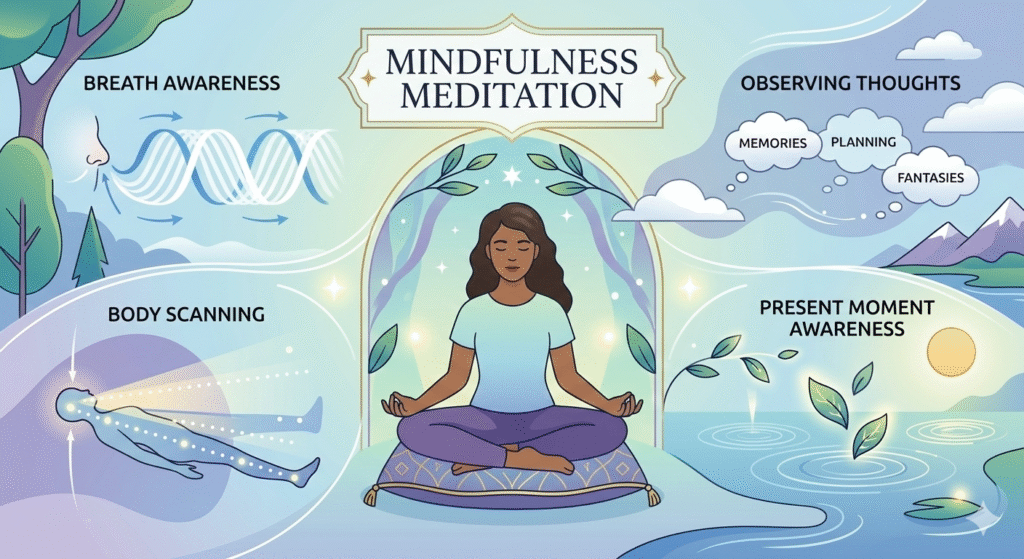
Practicing mindfulness for even 15 minutes every day can be a solution to many problems related to your emotional ups and downs. If properly practiced, this really can help. People of all ages are using this to make better changes in their ways of thinking and simultaneously in their lives.
So, what is mindfulness? How is it done?
Let us first see what mindfulness is about. Up next, we’ll learn how to perform mindfulness for beginners.
Mindfulness
From ancient times monks used to practice mindfulness for experiencing eternal peace. During that era, people perceived mindfulness as a means to connect with God. People would leave their homes and live in woods or mountains to learn this form. They had to train under a teacher to learn how to be at peace by forgetting all the terrestrial things that enticed or obstructed their mind.
It can be stated that initially mindfulness was developed from meditation techniques. Still, it is achieved with the help of some of those techniques.
In this practice, you bring your attention to the present moment, including the surroundings, sounds, and various sensations. You focus on the thoughts that often arise and observe them without any judgment. Overall, you have to be more compassionate towards the thoughts that unnecessarily knock the most.
Benefits: -
Overcoming Overestimation
There is always a fine line between how you should act on a thought and how you should not act after overthinking too much on that thought. Most of the inner and outer turbulences are created by overestimating a situation or thought.
The main purpose of learning this art is to learn how to draw this fine line every time you find yourselves stuck in uncontrolled thoughts.
Surely this does not work as easily as it seems while reading articles on it, but as we always say, persistence is the key to every small and big change.
Helpful for Teenagers

Teenagers are mostly live wires; their energy level is generally high and uncontrolled. That makes practicing mindfulness very advantageous for channelizing their energy in the right direction.
In their teens, people often face disorganized thinking about their education, relations, future, etc. At this age, exaggerating any normal situation or thought is normal, because every emotion might be new to them and every experience can be taken in differently.
However, many youngsters view meditation as something meant for middle-aged or older people. To them, it rarely fits into their fast lifestyle, and some also worry it might make them stand out or feel different from their peers.
Work/Life related Stress
In this workaholic lifestyle, stress and worries have become almost unavoidable. Stress can give rise to a range of mental health issues that make grievous changes in a person’s life. This often leads to conflicts within families, relationships, and social circles, which could be avoided if a person learned how to not overly exaggerate emotions. In times like these, mindfulness techniques for anxiety offer powerful support.
Overcoming Rumination/Daydreaming
An occasional daydream is considered healthy, but when you start daydreaming all the time, sooner or later it turns into rumination – a repetitive thought pattern. Then it becomes very hard to break this habit.
Proper mindful meditation is considered an effective remedy for a ruminating mind. Even psychologists and psychiatrists also recommend mindfulness meditation to begin with, apart from medication.
More Benefits of mindfulness: -
Mental and Emotional Benefits –
- Increases your ability to pause, reflect, and respond accordingly instead of reacting impulsively.
- Boosts focus and concentration.
- Gives mental clarity and improves decision-making.
- Helps break negative thought cycles and increases positive mood.
Physical Benefits –
- Helps you fall asleep faster and improve overall sleep efficiency.
- Lowers Blood Pressure.
- Some studies show improved immune response and reduced inflammation.
Let’s practice mindfulness for beginners. There are many ways to practice mindfulness, but it is most commonly exercised by sitting calmly and focusing on a specific bodily sensation.
Mindful Meditation
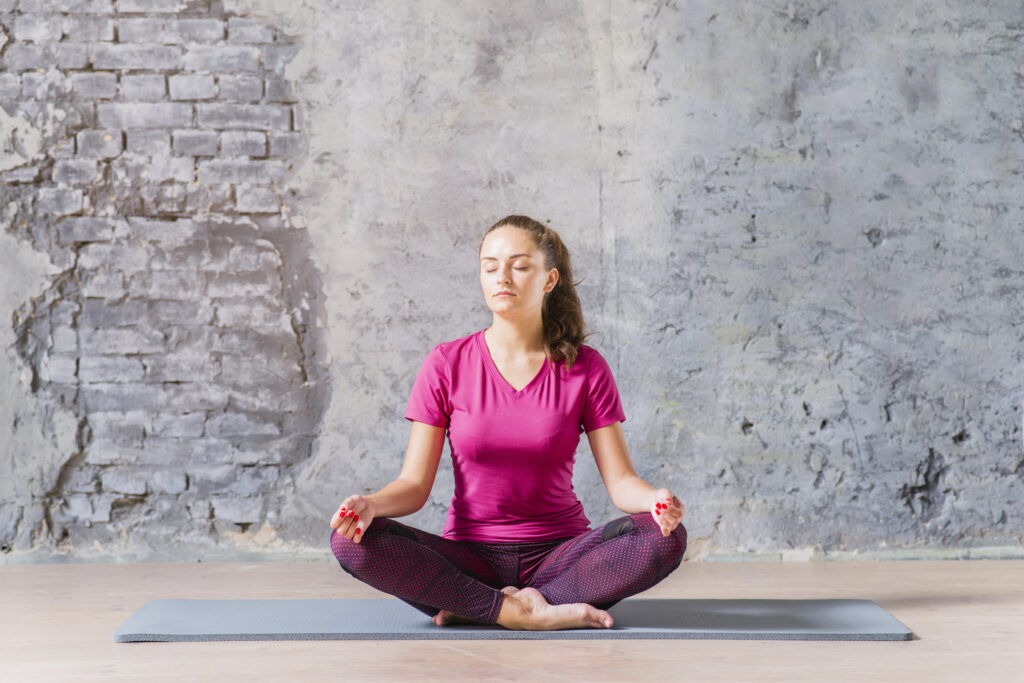
Basically, it is performed by sitting crossed-legged and focusing on breath or abdomen movements. The basic steps include:
- Sit in a comfortable posture, such as cross-legged (Sukhasana) or in a kneeling position. You can choose any surface—plain, cushioned, or grassy—as long as it feels comfortable and supportive to you.
- Keep your upper body vertical, with your spine straight. Rest your hands on your knees, either with palms facing down or up, and elbows gently bent.
- Close your eyes.
- Now here comes the most tricky but important part, i.e., breathing + focus. You have to focus on your breath and feel our abdomen movement. You need to let go of all the worries and distractions. Just focus on inhaling and exhaling.
- You can either inhale + exhale through the nose only or inhale through the nose and exhale through the mouth. Longer and deep breaths are more effective.
- For sure, the mind will wander; it is its basic nature. There is no need to get frustrated now; just bring the focus back to breathing gently each time you notice it drifting.
- Keep repeating this process with patience. As the different thoughts come, just let them pass without judgment and try coming to the present moment. Do not let the anger and frustration take over your mental calmness.
- Now, begin to observe any changes in your thoughts and emotional state.
Certainly, this takes a lot of practice. It might not be easy, but positivity and persistence are the keys to every meaningful change.
Self-observation
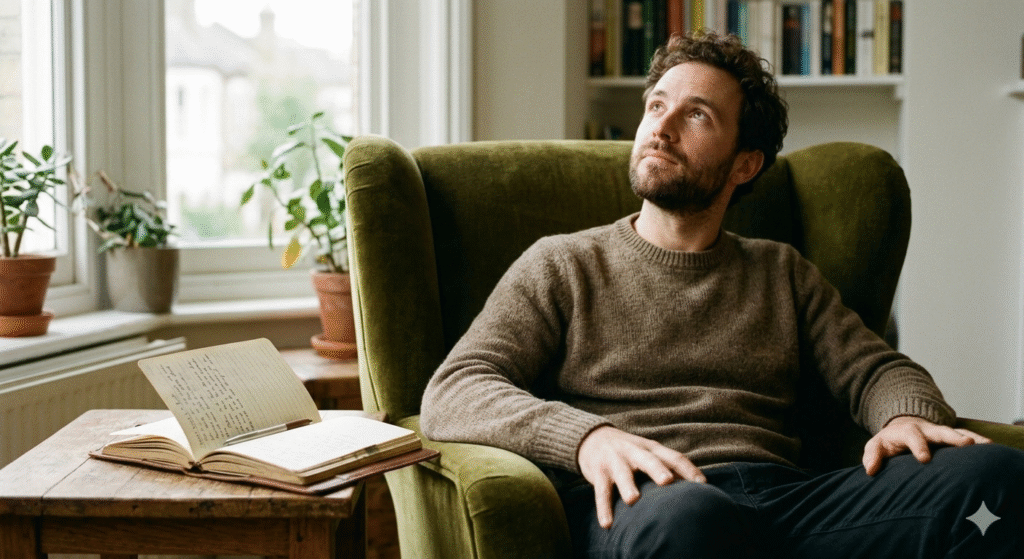
Our inner thoughts shape our outer world. If we know a bit more about our personality, then we can relate our actions with who we truly are.
Mostly we make our goals and standards that don’t match with our actual personality and interests. This brings us failure and then, later on, low self-esteem. So, if we know our standards prior to making a decision, we can better our chances of success.
How to do self-observation –
a) Create Space for Silence – Set aside a few minutes daily (start with 5–10 minutes). Sit quietly, away from distractions. You can also do this while walking or doing a simple task, but silence will be the basic requirement.
b) Focus on the Present Moment – Pay attention to what you are thinking, feeling, or doing in that very moment. Ask Yourself:
- What thoughts are running through your mind?
- How do you feel physically and emotionally right now?
- What are you into recently? Why are you doing it?
c) Label Your Experience – Name what you observe without judgment.
- “I’m feeling anxious.”
- “I notice tension in my shoulders.”
- “I’m thinking about tomorrow’s meeting.”
This helps you create space between yourself and the experiences rather than being consumed by it.
d) Watch Your Triggers and Patterns – Observe what causes certain emotions or actions. For example:
- “Every time I’m interrupted, I feel irritated.”
- “I shut down when I feel criticized.”
e) Use Journaling – At the end of the session or the day, write down what you observed. Reflect on repeated patterns, unexpected feelings, or internal conflicts. This strengthens memory and increases clarity over time.
While you may never fully understand yourselves, having some self-knowledge is still far better than having none at all.
Mindful Listening
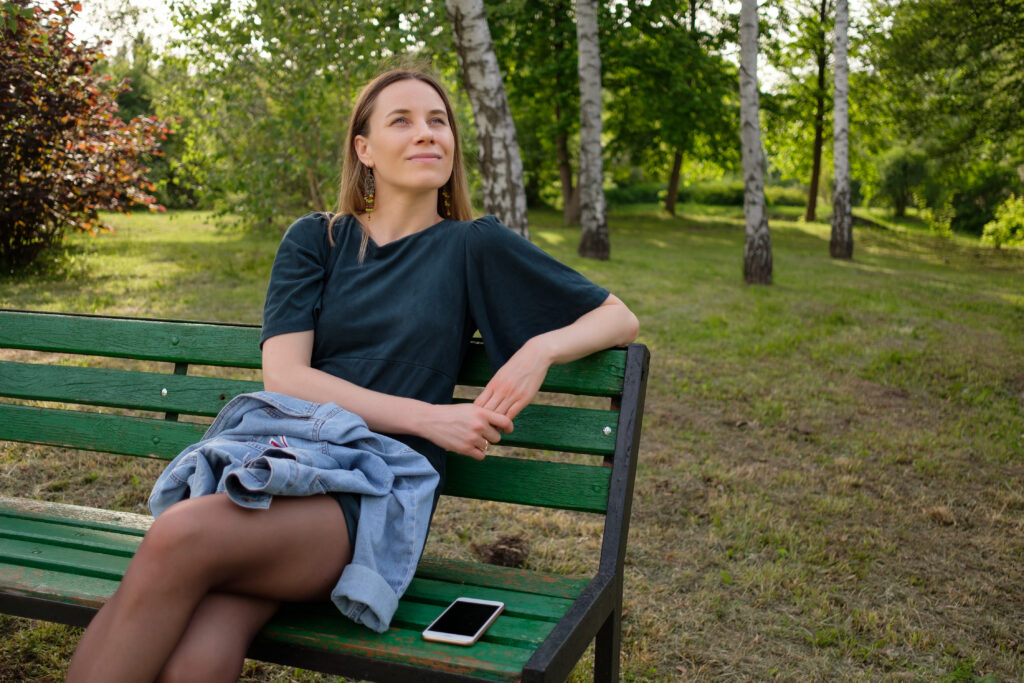
This practice can be done anywhere, but it would be better if you sat in a less crowded place like your house, a park, a balcony, a rooftop, etc., so that you would have to encounter fewer different noises.
This practice involves sitting still in a comfortable position and paying attention to the sounds, sensations, thoughts, feelings, and actions occurring in your surroundings. It helps improve focus and brings a calming effect to the mind.
Notice cars honking, birds chirping, the sound of a fan, or people moving nearby; just try to stay there.
If your mind wanders anywhere else, gently bring it back. It is optional if you want to close your eyes or not. This practice can be performed with eyes open as well.
Mindful listening also involves mindfully listening to the other person and what he is saying without getting distracted. Some simple steps are:
- Be fully present and put away all distractions.
- Make eye contact.
- Listen Without Planning Your Response. Let the speaker finish completely before you respond.
- Stay curious instead of judgmental.
- Pay attention to their tone of voice, body language, and facial expressions. Use open body language to show that you’re engaged.
Body Scan

This is also an effective way to practice mindfulness. This form is often overlooked by people, and the reason could be the popularity of other forms of meditation.
It is very much like the breathing meditation, but focus needs to be on body parts rather than the breath only. And the fun part involves, being able to lie down or sit comfortably (that is what our mind is always after).
- First you need to get in a comfortable position with no tight muscles, and this could be lying down on a soft surface or sitting upright in a chair.
- At this point, begin with some gentle breathing exercises to help settle the mind and body.
- Now, begin with any part of your body, such as the head, legs, or either hand—whichever you feel comfortable to start with. Bring your focus to that certain part of your body and breathe calmly. Try to hold on to every part for at least one minute, then slowly move on to the next one.
- As you move through the body, try to shift your focus to the area adjacent to the one you just observed, following a balanced and symmetrical flow.
- If you find yourself distracted by stress, frustration, etc., just stay calm and let these thoughts go by and bring attention to the body part again.
- Practice this art for at least 10 to 15 minutes.
Carry out this task in a manner that is beneficial to you and yields results.
Mindfully Eating Meditation
Eating mindfully helps develop healthier and more conscious eating habits by shifting your focus toward fully experiencing the food, rather than being distracted by TV, mobile screens, or wandering thoughts. One key benefit is that it helps you in differentiating between actual hunger and cravings (emotional or habitual) for food.
Not to mention that mindful eating is not dieting, but yes, it surely helps in weight loss goals. It also doesn’t mean you have to follow strict eating habits. If you are not on a weight loss mission (and do not have any health/medical issues), then things will not go south if we enjoy some snacks during mindfulness eating practice or special occasions somewhere.

Steps for Mindful Eating:
- Get something to eat like a piece of fruit, a few nuts, or a small portion of your meal.
- Touch and feel it first. Notice its smell, color, and quality. Notice everything in a non-judgmental way. Appreciate where it came from and what it offers your body. Do this for a while before reaching the next step.
- Notice if there is any change or sensation in your body. For example, an increase in saliva in the mouth or an increase in eagerness to eat it.
- Now start chewing the food. Eat it slowly and mindfully.
- While chewing, check the feelings that come to your mind. While doing this, leave the judge within us at a far place. Try focusing on positive aspects.
- Is the taste and flavor changing as we chew more and more? Is food getting softer over time?
- Now swallow it and feel it going down the throat.
- See if your inner self craves more. Check if your stomach is satisfied or not, and if it is satisfied, then is your craving compelling you to eat more?
We can practice this once, twice, or even thrice, according to the size and quantity of food.
Optional Reading
To improve eating habits, it’s helpful to organize your kitchen with healthy, nourishing food options. Eating alone at random places or consuming random food (less healthy) also contributes to more distraction and mindless eating. Having at least breakfast and dinner at home with family or a partner can make meals more enjoyable and mindful.
Walking Meditation

First of all, find a fine and quiet place to practice with little or no disturbance. Because this technique involves motions that are unfamiliar to those who are new to it. So, people might feel awkward seeing such activity.
Places like gardens, indoors, balconies, terraces, etc. would be a better option. Find a space at least 20 and at most 40 feet long where backward and forward movement is easy.
However, even if the space is small, say 10 feet, it is still possible to practice this mindfulness technique.
- Start Walking – Pace should be normal or slightly slower. Body posture can be usual, and hand position can be according to your ease. Take 10 to 20 steps in one direction and then stop. Now wait for a while and take two deep calming breaths. Now turn back and go to the starting point.
- Notice – While walking, pay attention to both your body and surroundings. Notice the sensation of each foot lifting off the ground, moving forward, and gently making contact again. Feel the contact between your feet and the ground. Check the movement of legs going forward and backward.
- Now shift attention to different sounds around you. Just listen to them calmly without labeling them or coming to different conclusions. Do it for a little while.
- Up next, bring your attention to your surroundings. Gently observe whatever is happening nearby—people, objects, or movements. Do not give a long gaze; just stay on things or people for a few moments, then change the object. Do this also for a while.
- Now you can move to scents that are present around you. Do not judge them as good or bad; just try to gather as much information about the smells present at that place.
- All in all, the goal is to remain completely present at that place both physically and mentally. These practices will support you in building a conscious and grounded personality.
- Stop – You can end this practice after at least 10 minutes or sooner at the beginner’s stage. Now notice the sensations in your body and calmness in your mind. You surely will find them to be positive. Now encourage your inner buddy to maintain the same calmness throughout the rest of the day.
As we have discussed earlier, the mind surely will wander, but there’s no need to be carried away by anger or frustration. Simply allow the thoughts to pass and gently bring your attention back each time.
Quick Tip – This practice can be added after any meal of the day, as it involves walking, which helps in better digestion of food.
Different Yoga Asanas
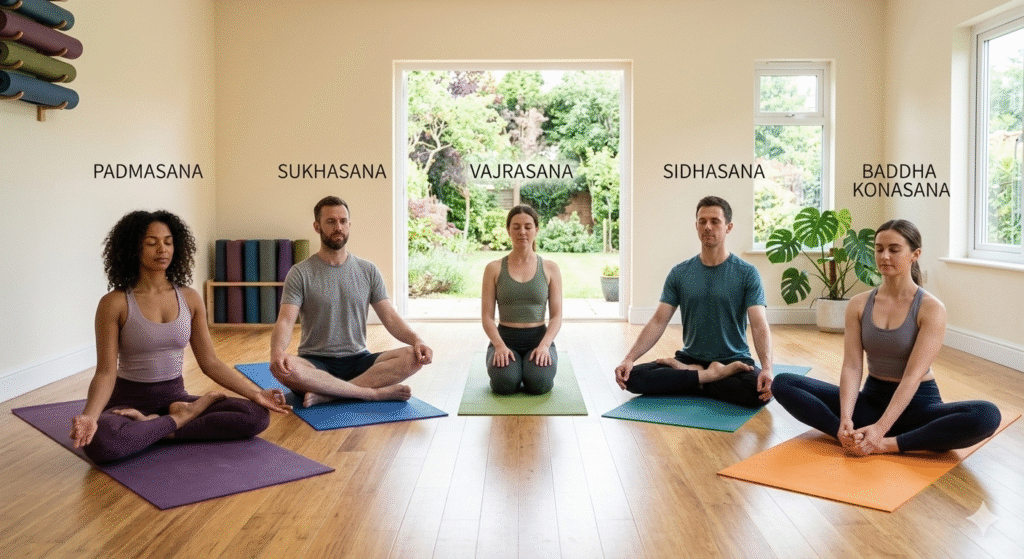
Yoga asanas used for meditation are primarily seated postures that promote stillness, spinal alignment, and comfort, allowing you to sit for longer periods without physical discomfort. These poses create a stable base and help maintain alertness while calming the mind.
One of the different benefits of yoga is that you become the controller of your life instead of letting things go in an autopilot mode. These asanas encourage you to do mindfulness meditation practice by providing you with proper and stress-free, comfortable positions.
Different asanas like Padmasana, Sukhasana, Vajrasana, Sidhasana, Baddha Konasana, etc., are very famous and exceptionally useful. These poses are also not so difficult that even a beginner can perform them easily. However, if someone experiences difficulty performing them, consulting a professional yoga instructor can be very helpful.
Optional Reading
Yogis and Sadhus have been practicing mindfulness meditation with the help of yoga asanas for centuries. Primarily, these originated in India and China and then spread across the world. Different asanas have been used for meditating in Hinduism and Buddhism since 1500 BCE or even earlier, according to different documented discoveries.
Closing Thoughts
In a world filled with constant noise and distraction, mindfulness offers a quiet path back to yourself. By learning to observe our thoughts, emotions, and surroundings with non-judgmental awareness, you open the door to greater clarity, emotional balance, and inner peace.
Mindfulness is not about escaping reality—it’s about fully experiencing it. Whether practiced through meditation, breathing, or simple daily awareness, mindfulness empowers you to respond to life with intention rather than reaction. With consistent practice, it becomes more than a technique—it becomes a way of living.