

What is mental exhaustion?
After a long period of strenuous work a person is likely to feel tired both physically and mentally. The mind can feel heavy, or a small headache may start at the end of the day. It can be counted normal as long as it goes away after a sufficient quantity of rest or required period of sleep.
But, if you feel exhausted in a way that your mind stays much heavier than normal most of the time during the day and regular things and tasks feel hard to complete with a blurred mind, poor focus, lack of motivation etc., then it could be signs of mental exhaustion.
Unlike in the old days, you might feel tired mentally and may be physically as well. A good sleep may work for physical tiredness but not for mental tiredness.
Do mental health conditions cause mental exhaustion?
Among the different reasons, yes, many mental health issues also contribute to mental fatigue. One fact you should be aware of that “mental tiredness itself is not considered a mental health issue, but rather one of the after-effects of different mental health conditions.”
There are different mental health issues that can cause mental exhaustion, like anxiety (social anxiety disorder), depression, chronic stress, ADHD, etc.
How anxiety causes mental fatigue?
If you have a long history of anxiety or issues like social anxiety disorder, then over time your brain starts feeling heavy most of the day. Even after having an adequate amount of sleep, you might not feel as energetic as you used to be.
- Being constantly on edge –
On having anxiety issues, your brain stays on alert mode i.e., ‘fight or flight’ mode most of the time, even if there is no danger near to you. This no-rest condition wears out the brain more easily and quickly.
“Did I make a mistake?”
“What if something goes wrong?”
“What will people think?”
A chronically anxious person’s day is spent answering these kinds of questions.

- Poor sleep –
If you have anxiety issues, then there could be chances of you having poor sleep issues, like trouble falling asleep, staying asleep, or getting restful sleep. Because even during sleep your mind stays in alert mode. This cutback for a long time gives rise to mental fatigue.
- Physical strain –
When you are in anxious mode, then your body shows different changes–fast breathing, muscle tension, and fast heart rate simultaneously. These actions require an excess amount of body energy, which ultimately drains the body’s energy much faster. Over time if your body starts facing this often, then this also affects your mental energy sooner or later.
- Everyday tasks become more difficult –
Our subconscious mind naturally reads that energy and body language of a person near to us. An adequate amount of energy is very important while sitting in a group or even with a single person.
An anxious person doesn’t matter how much he tries to pretend to be normal, conveys certain signals, and becomes an odd one out in a group. So in a way to behave normally that person has to put in extra effort. This behavior also needs some extra amount of mental energy, which ultimately drains the energy pot.
This also hampers the decision-making, focus and that leads to an unmotivated self.
How depression causes mental fatigue?
Depression can play a vital role in causing mental fatigue because it affects different brain functions like attention, motivation, and especially memory.
Here’s how it happens:
- Affects Neurotransmitters – Different neurotransmitters like serotonin, norepinephrine, and dopamine help the body maintain mood, focus, and energy. Depression generally changes the levels of neurotransmitters in the body, and simultaneously you feel less energetic. Staying alert can become a hard task even in day-to-day affairs like reading, writing, grocery choices, etc.
- Negative Thinking- A mind full of depressed thoughts gives an invitation to negative thoughts sooner or later. Negative thoughts make a layer around our normal thinking process and try to control it. These thoughts use mental resources on a big level. In the end, it reduces the brains efficiency that controls planning, decision-making, focus etc.
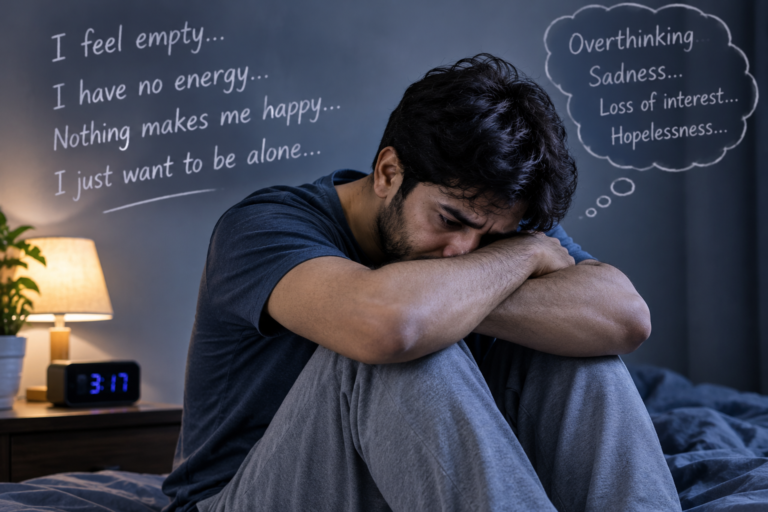
- Sleep Deprivation – Depression may bring you sleep disorders.
- Insomnia
- Waking up early
- Waking up frequently
- Sleeping more but not feeling energetic
Not even a good amount of sleep pays you well, and you face both physical and mental fatigue.
How depression causes mental fatigue?
According to experts, a little amount of stress can be useful for you in many ways. It improves your work quality by increasing the attention and recall power. But high stress for longer time periods can bring many other repercussions.
- Increased flow of cortisol –
This hormone is responsible for transferring the body and mind to fight-or-flight mode. When your nervous system detects a threat, it increases the flow of cortisol. As your mind senses you are out of the woods, cortisol level decreases, and your body comes to a stable state again. But in constant stress conditions, the flow of this hormone does not break, and that’s why the body stays in alert mode for an unnecessarily longer time.
This phenomenon affects certain parts of the brain, like the prefrontal cortex, amygdala, hippocampus, etc. Due to this, different cognitive aspects are also affected, like self-control and memory, and it heightens fear and anxiety.
- May cause Migraine –
According to studies, over 80 percent of the people who have been diagnosed with migraine have reported stress as the main factor behind it. Our brain shows an adaptive behavior towards different kinds of stresses by bringing our mind and body into a stable state. But as the frequency of different kinds of stresses increases, this behavior gets overused and shows some dysfunction over time.
With stress, cortisol hormone gets secreted more than usual; it may play a role in changing the brain’s capabilities. Chronic stress that comes with mental health issues like ADHD and PTSD can also play a drastic role in migraine attacks.